

INT - Value-chain development and market systems
Integration depends on the bottlenecks identified in the market systems analysis. These might not be relevant in all contexts, so intervention areas should only be selected on the basis of a solid analysis of the local market. Where suitable, value chains offer various possibilities for integrated approaches, notably in business development services, financial inclusion and cooperative development, as they help producers achieve scale.
Here are a few examples of integration within the PROSPECTS programme with regard to market systems and value-chain development:
Guidelines - Gender and disability inclusion
Mainstreaming Inclusion
- Include women and persons with disabilities in mainstream programme activities, rather than separate interventions. Here is one example of how a refugee with hearing impairment acquired tailoring skills as part of a Technical and Vocational Education Training (TVET) programme supported by ILO PROSPECTS in Egypt.
Consultation and engagement
- Engage women and persons with disabilities in dialogues to identify appropriate and refine interventions.
- Develop reference materials to help programme teams facilitate policy dialogues.
- Consult with organisations of persons with disabilities (OPDs) to ensure meaningful participation in programme planning, implementation and evaluation.
Tools and resources
- Utilise tools like ‘10 Tips on Making Disability Inclusion a Reality in PROSPECTS’ which offer concrete goals and tips to increase meaningful involvement of persons with disabilities, while integrating a gender perspective.
- Implement training programmes such as ‘How to consult organisations of persons with disabilities (OPDs)’ to build capacity.
Data collection and analysis
- Conduct surveys to map the prevalence, needs, and barriers faced by persons with disabilities and their caregivers to inform targeted interventions and policy development.
- Disaggregate programme data by disability status and types, alongside age and gender to monitor inclusion.
Training and capacity building
- Provide training to vocational instructors, staff, and implementing partners on disability inclusion and gender-inclusive practices and policies.
- Offer training in inclusive skills methodologies adapted to persons with various types of disabilities.
Inclusive Structures
- Establish structures like the Youth Network Committee (YNC) Subcommittee on Gender and Disability to ensure the integration of gender equality and disability inclusion across all activities.
- Train members of these subcommittees on gender and disability inclusion to act as an oversight for inclusive measures.
FR - Gender and disability inclusion
'Emerging and key areas of intervention' in Responding to Forced Displacement report
Image
ILO training materials & course
ILO, Making Disability Inclusion a Reality in PROSPECTS: Concrete Goals and Simple Tips, undated
ILO, Start and Improve Your Business (SIYB) website, accessed 2025
ILO, GET Ahead training material website, accessed 2025
Local perspectives on gender and disability inclusion
Uganda: Uganda Women Entrepreneurs Association Limited (UWEAL) website, accessed 2025
Jordan: ILO, Estidama++ Fund – Extension of Coverage and Formalization in Jordan, website, undated
Strengths - Value-chain development and market systems
Tailor-made solutions based on market forces
The AIMS approach analyses the dynamics of local markets, identifies constraints and works to strengthen relationships between actors, business networks and other support functions. This can be triangulated with data from local value chain actors, to support buy-in of the solution.
Focuses on bottlenecks hampering inclusive growth and job creation
The approach recognizes that vulnerable groups, including refugees, face barriers to access and benefit from the market. It aims to ensure market interventions are inclusive and accessible by design.
Potential to last beyond the project life cycle
The AIMs approach builds capacity locally, so that producers, entrepreneurs, workers and other market actors can benefit from market opportunities that are simultaneously stimulated through pull approaches. This fosters market dynamics that can persist beyond the project duration.
Supporting camel-milk value chain
Image
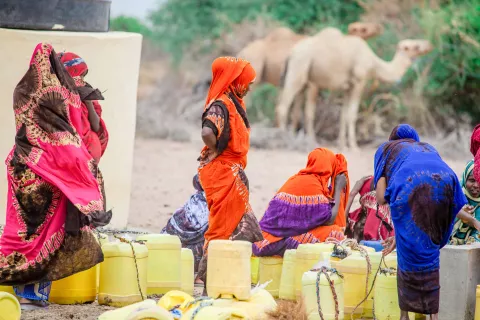
By rehabilitating key water infrastructure using labour-based methods and training water resource operators, the initiative bolstered camel-milk production, tripling output and generating new jobs.
Following three years of severe drought in Garissa County, camels emerged as a critical source of resilience – providing both nutritious milk and a sustainable livelihood – particularly for women, young people and the elderly in the villages. The PROSPECTS team adopted a market systems approach to strengthen the camel-milk value chain. By rehabilitating key water infrastructure using labour-based methods and training water resource operators, the initiative bolstered camel-milk production, tripling output and generating new jobs. The establishment of the Kasha Camel Milk Collection Centre empowered women through entrepreneurship, raising hygiene standards and expanding market access.
Find out more about the PROSPECTS programme’s wider learning on gender and disability inclusion.
Gender and disability inclusion
Overview
Gender and disability inclusion are critical considerations, particularly for forcibly displaced persons who face significant disadvantages in accessing training, employment, and social protection. Within this group, there are sub-groups that experience unique challenges, making it crucial to understand how disability and gender combine with the experience of forced displacement. Consultation with women and people with disabilities was foundational for the development of relevant and meaningful support.
Therefore, developing effective and tailored support requires a comprehensive approach that actively engages with women and persons with disabilities as equal partners. It also means mainstreaming inclusion rather than creating separate interventions, and engaging with organisations of persons with disabilities and individuals with disabilities in the programme design.
Image
Key stakeholders
- (I)NGOs
- Community based organizations
- Organizations of persons with disabilities (OPDs)
- Government representatives (national and local)
- Refugees, internally displaced persons (IDPs) and host community members
14 of 9