The ILO and UNHCR conducted a study in Ethiopia and found that enrolling urban refugees and asylum-seekers on to a community-based health insurance scheme is feasible, improves financial protection and could reduce UNHCR costs.
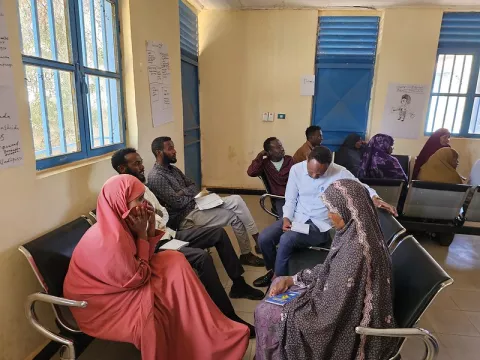
In Ethiopia, the ILO and UNHCR conducted a study to assess the feasibility of enrolling urban refugees and asylum-seekers in the community-based health insurance (CBHI) scheme in Addis Ababa. The study found that this was feasible and offered advantages over the UNHCR-provided life-saving and emergency treatments, in that CBHI inclusion would not only improve the financial protection of the target group when accessing health services but also potentially reduce UNHCR costs, as life-saving treatments were much more expensive.
Refugees were accessing free primary healthcare services, but had to pay out of their own pockets for secondary and tertiary care. The study evaluated the legal framework and the benefit package and service providers under CBHI. A major difficulty was the limited information that social protection providers had on the contributory capacity of refugees in Addis Ababa, meaning they mainly classified them according to their residential status, that is, under Urban Assistance Programme, Out-of-Camp Policy and self-relocation. The study suggested several ways forward and served as the basis for engaging the government and partners in providing services to refugees. The technical questions were reviewed in a technical working group that was established to address the operational aspects for including refugees and asylum-seekers in the CBHI scheme.
In this video, see how Habiba Moghe Hussain, a Somali refugee, transformed her cattle business after winning Ethiopia's Business Plan Competition, and now aims to establish a women's livestock cooperative to empower her community.
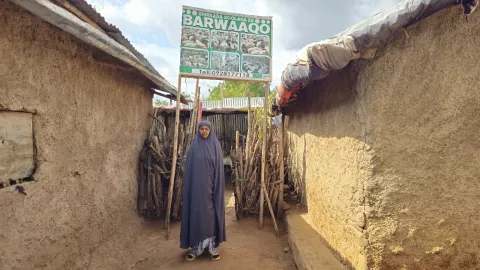
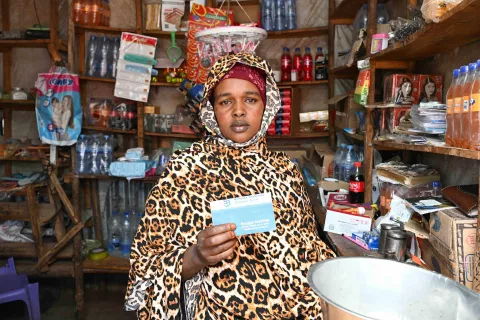
Habiba Moghe Hussain, a Somali refugee and mother of three, transformed her cattle-trading business after winning a Business Plan Competition in Ethiopia. Supported by the Netherlands, the ILO and Hasi Consulting, the competition helped her refine her business strategy and awarded her a grant of US$900. With additional support from business development services (BDS), she was able to draft a formal business plan and start keeping proper financial records. Filled with renewed confidence, Habiba dreams of establishing a women’s cooperative focused on the sale of all types of livestock for others in her community.
The ILO and the Association of Ethiopian Microfinance Institutions’ partnership strengthened financial inclusion and resilience for refugees and host communities through integrated financial education and microinsurance initiatives.
The Association of Ethiopian Microfinance Institutions (AEMFI), established in 1999, is a non-profit, non-governmental body promoting microfinance in Ethiopia. With a network of 52 member MFIs, the AEMFI provides a platform for knowledge exchange, advocacy, capacity-building and performance monitoring, all of which focus on delivering financial services to vulnerable communities, including refugees and host communities.
In 2021, the AEMFI and several of its member MFIs participated in the ILO training Making Finance Work for Refugees, Displaced and Host Communities. This capacity-building programme was designed to equip financial institutions with tools to serve forcibly displaced populations. The training focused on adapting financial services to the unique needs of refugees and host communities and explored strategies to address financial inclusion challenges in underserved areas. Through practical guidance and the ILO’s inclusive methodologies, the AEMFI members gained essential skills to support refugee financial inclusion, highlighting a commitment to socio-economic integration.
In parallel, the AEMFI also championed the institutionalization of financial education within its network. Through the ILO’s Financial Education Programme, member MFIs have implemented comprehensive financial literacy initiatives that help individuals and families understand essential concepts in savings, budgeting and debt management. The AEMFI has played a central role in expanding financial education through training trainers in the ILO’s FE programme, enabling the development of a robust network of national and regional trainers. By leveraging the ILO’s structured training materials, which cover core financial literacy principles and adaptive strategies for refugees and host communities, the AEMFI ensures that trainers are well-equipped to educate diverse client groups in managing their finances sustainably.
Additionally, the AEMFI and the ILO, recognizing the need for risk mitigation and financial security, collaborated to introduce microinsurance as a valuable addition to MFI service portfolios. This initiative aligned with recent regulatory changes introduced by the National Bank of Ethiopia, under which MFIs are mandated to offer microinsurance to safeguard movable assets, often pledged as collateral. Microinsurance, which is especially critical in high-risk sectors like agriculture, addresses both borrower vulnerability and lender risk.
In December 2024, the ILO and the AEMFI delivered intensive microinsurance training for Ethiopian MFI managers and independent trainers, covering the diversification of financial products, client-centric product development and best practices in risk management. This workshop, informed by the local context and international case studies, equipped participants with the knowledge to design and implement effective microinsurance solutions. By incorporating microinsurance, MFIs can better serve rural and underserved communities, enhancing the resilience of both FSPs and their clients.
This partnership between the ILO and the AEMFI exemplifies a sustainable model for the financial inclusion of refugees and host communities in Ethiopia, embedding financial education and microinsurance within the strategic framework of MFIs. The collaboration strengthens both the institutional capacity of Ethiopian MFIs to support refugee and host communities through inclusive financial services and the financial resilience of the communities they serve, promoting long-term socio-economic stability.
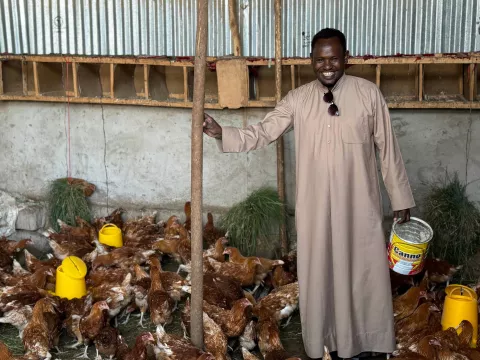
This video shows how a young poultry farmer from Jigjiga, transformed his business with the help of a grant and business training through the ILO's Business Plan Competition in Ethiopia’s Somali region.
Mukhtar, a young farmer from Jigjiga running a micro-sized poultry business, was aware of increasing market demand for poultry in Ethiopia’s Somali region. The first-generation entrepreneur has a wife and three kids and was planning to grow his business to improve his livelihood. However, lack of access to formal sources of finance limited his ambitions. His participation in the ILO Business Plan Competition (BPC) supported by and Hasi Consulting proved to be a gamechanger.
Find out more about the PROSPECTS programme’s wider learning on youth engagement.
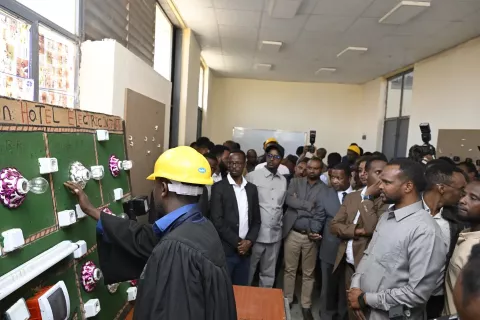
The ILO, together with the Lutheran World Foundation, is building a Technical and Vocational Education Training Centre in Kebribeyah, Ethiopia. The centre, which is located in the vicinity of refugee settlements is designed to provide vocational training opportunities for both the host community and refugees.
In Ethiopia, the PROSPECTS team supported an initiative to establish a satellite TVET training centre in the district of Kebribeyah, in Somali Regional State. The satellite centre was the country’s first public TVET training facility in a refugee-hosting area. As a result, jobs were created for refugees and host community members during the construction of the centre itself, subsequently vocational training was provided to refugee and host community students who would otherwise have to travel long distances for TVET training (the closest public vocational training college was 55 kilometres away, in the regional capital, Jigjiga).
Consultations were organized with local stakeholders in Kebribeyah to promote buy-in and ownership, and to provide guidance on relevant, in-demand occupations, including finishing works in construction, general metal fabrication and aluminium works, electrical installation, plumbing and sanitary installation, irrigation technology and cobblestone-laying. Trainers from Jigjiga Polytechnic College were then trained as trainers to deliver courses in the satellite centre. As a component of the cobblestone course, graduates were awarded a trial contract to construct a 500-metre cobblestone road as a demonstration site for EIIP in Kebribeyah. Similar to the case in Kenya, this supported the upskilling of local refugee and host community labour, using a labour-based approach.
Find out more about the PROSPECTS programme’s wider learning on youth engagement.
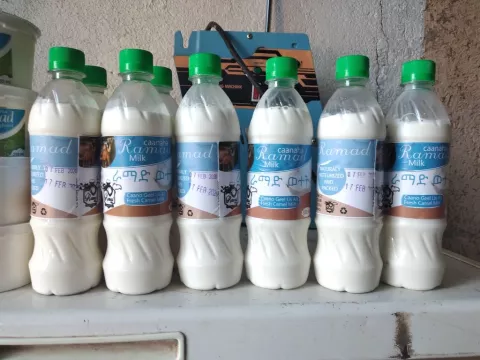
PROSPECTS used Employment-Intensive Investment Programmes (EIIP) to construct water and milk storage facilities to improve livestock rearing and milk production, while also building capacities building and providing local employment opportunities.
In 2019, in the Fanfan Zone of Somali Regional State and Jigjiga, PROSPECTS extended the EIIP approach followed as part of a wider value-chain development programme. This extended approach focused on enhancing the livelihoods and added value of livestock-rearing and milk production. After an assessment of challenges and bottlenecks in the value chain, animal health and milk productivity were identified as areas of focus. A key issue within these was water access during dry seasons, which is a major determinant of both the quality and quantity of milk produced.
Because the EIIP approach was new in these areas, the intervention included a period of capacity-building and awareness-raising around the EIIP approach, involving district-level officials, private sector contractors and workers. PROSPECTS collaborated with the Bureau of Pastoralist Development and local administrators on such issues as land acquisition, community mobilization and handover to the local community at the end of the EIIP. The Bureau was also overseeing work as part of the wider value-chain development programme and so could advise based on a wider objective to develop the market.
To address the issue of water scarcity in dry seasons, two detention ponds were constructed using do-nou technology, a Japanese method that uses gunny bags filled with sand or soil and compacted manually to level and reinforce dirt roads. This is a durable, yet simple technology, the materials for which can be sourced locally. Additional facilities included water points and cattle troughs. Two technicians were also trained as community resource personnel, to provide support and maintenance after the construction ended.
To address productivity bottlenecks the PROSPECTS team and the Bureau of Pastoralist Development jointly prioritized cooperative development, the construction and enhancement of milk-storage facilities, and improvements to road infrastructure. A milk collection and cooling facility was constructed so that milk would have a longer shelf life and be preserved during transport to nearby markets. Water sources were constructed so that livestock would have water all year round in the arid climate, while the pooling and storage facilities prolonged the shelf life and hygiene of the milk.
The cooling facility was designed according to national standards and requirements set by the Ministry of Agriculture and Livestock. It was constructed by local contractors from Somali Regional State, who, in turn, employed refugee and host community members from the surrounding area. In all, 134 community members worked on the EIIP construction, while approximately 585 individuals and approximately 5,080 animals had access to the improved facilities.