
Image
uganda

Pilot apprenticeship programme in the hotel sector in Uganda

Submitted by iloadmin on
Image
Image of three people, one of them dressed in a chef's uniform talking to the others

Design and pilot an apprenticeship scheme with the intention of modelling and replicating the pilot on a national level to address skills gaps and improve employment opportunities for young people, including refugees.

In Uganda, apprenticeships had been identified as a national tool to address skills deficiencies in the labour market. Consequently, in 2018, the Cabinet approved the Uganda National Apprenticeship Framework (UNAF) and directed the Ministry of Gender, Labour and Social Development (MGLSD) to design and implement a National Apprenticeship Scheme. In doing so, national counterparts adopted a vision of WBL that offered hands-on skills development, engaged employers and tailored learning so that it aligned to industry needs. PROSPECTS partnered with the MGLSD to design and pilot apprenticeship schemes with the intention of modelling and replicating pilots on a national level under the UNAF. The MGLSD identified the hospitality sector for the pilot, based on Uganda’s growing hospitality and tourism industry and the sector’s status as one of the largest employers of young people. Hotels and the service sector were also inclusive of refugees, with several three- and four-star hotels located close to the main refugee-hosting areas.

The MGLSD helped convene key players in the hospitality sector, and coordinate and monitor compliance with UNAF guidelines, the labour law and related employment policies. Hotel owners were represented by the Uganda Hotel Owners Association (UHOA), whose role was to mobilize employers, recruit apprentices and coordinate workplace training. An important measure was to ensure that the UHTTI and hotels could offer accommodation to apprentices during their training and work placements, particularly refugees coming from the settlements. The Uganda Hotel and Tourism Training Institute (UHTTI) led on the development and delivery of the training curriculum, and on the assessment and certification of apprentices, in coordination with the Directorate of Industrial Training (DIT). The DIT administered the government trade tests and issued trade certification. Workplace supervisors in each of the selected hotels were responsible for the apprentices and their learning outcomes. PROSPECTS developed a supervisors’ manual and training to help supervisors take up the role.

For the curriculum, four trades were identified in the hotel sector: food production, food and beverages, housekeeping and front-office management. The overall curriculum development process was led by the UHTTI, but all other partners (UHOA, DIT, MGLSD) were involved in the design and approval processes. Key to the curriculum development process was input from the hotel owners, who provided practical insight based on their day-to-day operations and business needs.

Apprentices spent 25 per cent of their time on theoretical training and 75 per cent on on-the-job training. PROSPECTS guided the UHTTI on specific outreach and training approaches that were accessible to refugees, with an emphasis on promoting social cohesion and assessing learning outcomes. PROSPECTS also supported the development and production of teaching materials and aids for TVET instructors and facilitators. These included training for facilitators in the use of the ILO handbook, Promoting Social Cohesion and Peaceful Coexistence in Fragile Contexts Through TVET. Trained facilitators included refugees from RYLOs who were supporting the rollout of TVET in the Nakivale settlement.  

The process of selecting apprentices was rigorous and time-consuming, but this was necessary to ensure employers and apprentices both experienced positive outcomes. Apprentices had to have a foundational skill set and motivation to pursue a career in the chosen profession. The application process involved several rounds of interviews, conducted by the UHTTI and UHOA, to assess foundational skills and work readiness. Although the young people targeted did not have to have previous work experience in hospitality, they did have to show enthusiasm for pursuing a career in the sector and the capacity to work independently. They were recruited from the Isingiro, Madi-Okolla and Terego districts, including from the two refugee settlements within them (Nakivale and Rhino). During the on-the-job training, apprentices first rotated among four trades to get a holistic appreciation of trades within the hotel industry, before choosing one of them to focus on for the remainder of their work placement. Throughout the course of the apprenticeship, apprentices maintained a logbook of learning, which was checked on a weekly basis by a workplace supervisor. These checks were used to monitor learning and ensure that the hotel was providing sufficient opportunity for the apprentices to work towards their predetermined learning outcomes. At the conclusion of the 12-month programme, the apprentices underwent theoretical and practical examinations administered by the UHTTI and hotel staff.

Of the first cohort of 100 refugee and host community trainees, 94 completed the training and graduated. The pilot helped raise the awareness of employers in the hotel sector of the availability of committed and skilled refugee workers at district level. Previously, many hesitated to employ refugees, believing that their temporary status and the fact that they lived in remote areas made them less reliable as employees. Having onsite housing for participants helped by giving young refugees the opportunity to prove themselves as committed and reliable trainees. One hotel reported that a refugee apprentice from a Francophone country had helped forge business with French clients and improve customer relations and ratings. This was only one anecdote but it does illustrate the value of having a diverse workforce and the skill sets refugees can bring to local businesses.

For the apprentices themselves, the programme opened doors to those who faced barriers in translating classroom-based training into a workplace environment. The training administered by the UHTTI involved cost and other logistical barriers that otherwise put the training beyond the means of the target group (refugee and host community young people not in employment, education or training). The programme covered enrolment fees at the UHTTI and provided living stipends for the duration of the pilot. These costs could be shared or covered by government bodies and employers in the longer term. The training was found to be highly practical and the nationally certified programme helped apprentices build experience and transferable credentials. The UHTTI found the training model practical and subsequently designed similar courses for the industry. In addition, it initiated work independently to collaborate with more industries on WBL, marking a notable shift away from the more general courses it had provided in the past.

The pilot also attracted attention from other donors, including the World Bank and the European Union, which supported two additional apprenticeship programmes designed by the MGLSD. The UHTTI, through the Ministry of Tourism, also attracted funding from the Ugandan government to run apprenticeship courses based on the PROSPECTS model. The government confirmed a funding line in the national budget to cover the costs of apprenticeships in the hospitality sector in subsequent years. It has since reviewed the curriculum and added two modules on pastry and barista/bartender, with approval by the National Curriculum Development Centre (NCDC). 

Success stories of trainees:

Find out more about the PROSPECTS programme’s wider learning on youth engagement.

Promoting social cohesion and peaceful coexistence in fragile contexts through TVET

Submitted by iloadmin on
Image
Image of a female trainee working on cutting metals with protect gloves and protect glasses on

Piloting a training guide to promote social cohesion in collaboration with TVET practitioners in various countries.

Promoting Social Cohesion and Peaceful Coexistence in Fragile Contexts through TVET is a guide that was developed to strengthen the role of TVET practitioners as active promoters of social cohesion. It provides practical guidance to trainers and managers of training centres on how to adapt delivery to mixed groups of students; embed conflict-resolution skills, cooperation and other relevant core skills into training curricula; and create conflict-sensitive, inclusive and diverse learning environments for all. The guide sets out a four-day curriculum to build the capacities of TVET trainers in facilitating core skills in social cohesion, so that they are able to include social cohesion elements in their skills development curricula.

Sample four-day curriculum:

  • Day 1: Creating the learning group and wider context
  • Day 2: Understanding social cohesion in fragile contexts working with youth and adults – the role of the trainer
  • Day 3: Exploring resources: what we bring and what else is out there to promote inclusion
  • Day 4: Assessing social cohesion and preparing for change

The guide was piloted under PROSPECTS in Kenya, Jordan, Ethiopia and Uganda, in cooperation with the Peaceful Change Initiative. A total of 73 trainers took part in a training-of-trainers session on incorporating conflict-sensitive methodologies and elements into the design and planning of vocational training programmes. In the Kenya pilot, occupational standards for technical trainers and the corresponding teacher-training curriculum were revised to take account of the role of trainers in promoting social cohesion and peaceful coexistence, following the guide. 
 

Combining push and pull interventions

Submitted by iloadmin on
Image
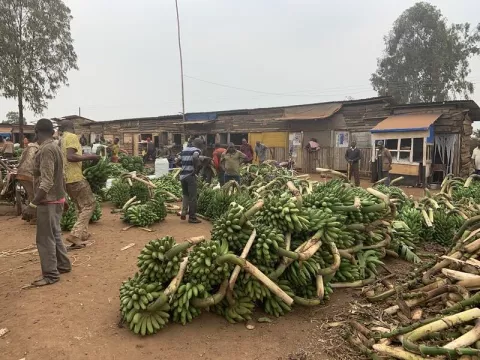
Image of a market with banana bunches on display and buyers and sellers negotiating in the background

Lessons from the PROSPECTS Uganda-Ag-Ploutos partnership using both push and pull interventions

PROSPECTS Uganda conducted an AIMS assessment that identified challenges and opportunities in supporting sesame and cassava value chains, highlighting their potential to provide livelihoods for refugees and host communities. The assessment identified several constraints, including inconsistent and low-quality input supplies, a lack of downstream agri-dealers or agents, inadequate farming practices, inconsistent supply for aggregation, poor post-harvest handling and limited market access. In response, the project began identifying private sector partners with the capacity and commercial incentive to engage with farmers in these underserved areas. Through an open call, Ag-Ploutos was selected as a partner.

Ag-Ploutos is an agricultural company that specializes in strengthening food supply chains by collaborating with public and commercial entities, including governments, cooperatives and farmers. Through its agent network it provides aggregators with quality inputs, extension services, financing, crop insurance and access to credible markets. The company had already identified a business opportunity in expanding its reach to 30,000 farmers in new territories and had already planned to expand into the West Nile region to increase its pool of quality sesame suppliers for high-end export markets. As the company’s manager explained to the programme team, it would have eventually expanded into West Nile with or without PROSPECTS’ support; however, the opportunity to work together substantially accelerated its penetration of the local market, enabling it to achieve its expansion goal in just one year instead of three. This also demonstrated that the business case was sound and aligned to the company’s own objectives. 


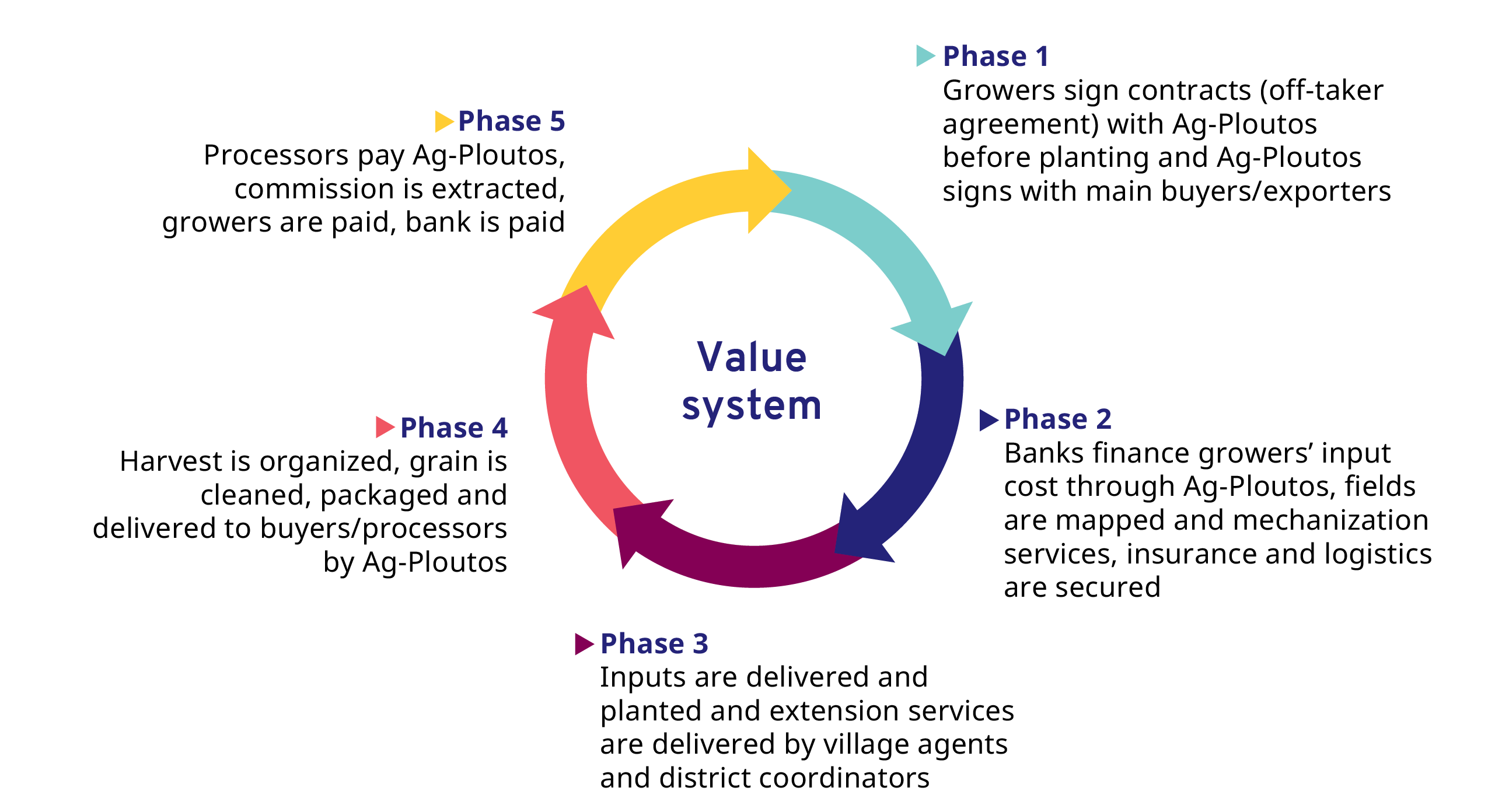
The model that was developed with Ag-Ploutus can be broken down into five phases. The graphic above illustrates these and clearly shows how the partnership facilitated access to export markets by de-risking transactions between large export buyers, banks and small-scale farmers. The phases were as follows: 1) the grower signs contracts with Ag-Ploutos, which, in turn, signs contracts with export buyers; 2) based on the guarantee provided by these contracts, local banks agree to finance growers’ input costs through Ag-Ploutos, which will recover the loan on behalf of the bank. At the same time, fields are mapped and mechanization services, insurance and logistics are secured for the growers; 3) inputs are delivered and planted, and extension services are implemented through a network of trained village agents and district coordinators; 4) village agents buy back the sesame production from farmers, deducting a pre-financing cost of the inputs from the total. Ag-Ploutos aggregates the sesame harvest locally and has it cleaned, tested and packaged in Kampala; 5) export buyers pay Ag-Ploutos, a 5% commission is extracted for the village agents and the loan to the banks is paid back.

Alongside the extension services, the programme team facilitated training with the National Organization of Trade Unions to train farmers in occupational safety and health. This addressed decent-work deficits observed at the farm level and served to support compliance with export buyers’ requirements.

Because the farmers involved were small-scale and largely unregistered, Ag-Ploutos also developed a digital profiling tool for the farmers, accompanied by an evaluation tool. The profiling tool provided basic information about the farm, such as crops grown and geographical area of operations. The evaluation tool allowed farmers to receive ratings from buyers, which helped legitimize their operations. The evaluation tool was also expanded to predict productivity potential of the farms and evaluate compliance with labour standards. The two tools were adopted by banks for the purpose of due diligence, which also helped previously unbanked farmers access finance. 

Results:

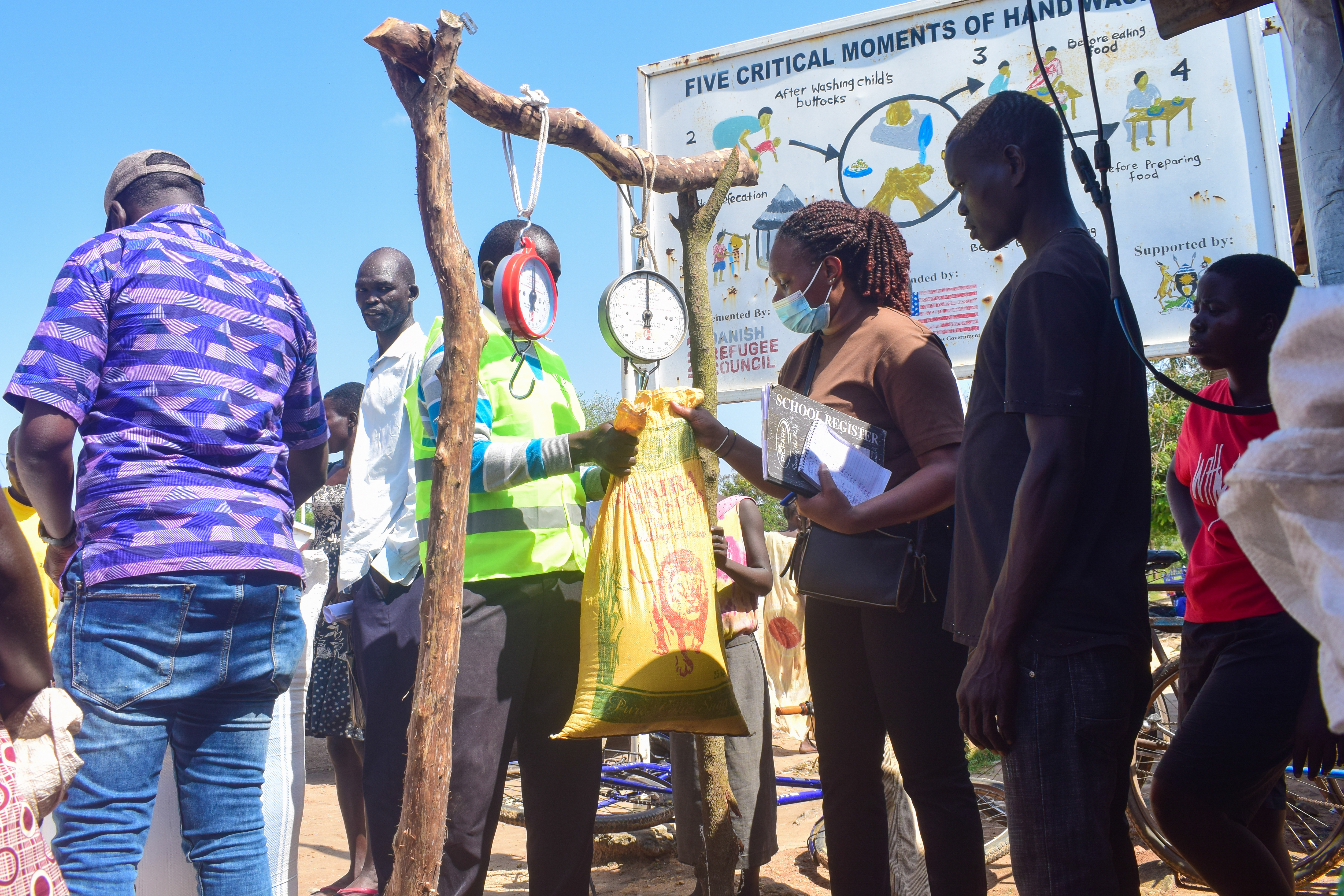
  • In all, 5,740 refugees and host community farmers had access to inputs and extension services, as well as guaranteed access to export markets.
  • In one season, 350 tons of sesame worth US$420,000 were produced and aggregated.
  • The new seed variety introduced by Ag-Ploutos improved farmers' yields, increasing them from 100 kilograms per acre to 500 kilograms.
  • Farmers’ revenue increased by a minimum of 150,000 Ugandan shillings (US$40) and up to 800,000 shillings (US$216) in one season.  
  • In total, 890 individual bank accounts were opened for farmers at Equity Bank.
  • Overall, 215 businesses were started in the sesame value chain.

Find out more about this project in these reports:

Entrepreneurship training combined with support for youth employment in Uganda

Submitted by iloadmin on
Image
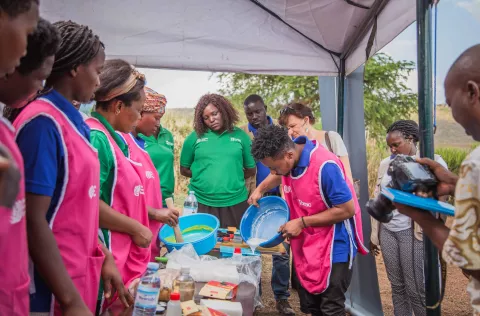
Image of a group of trainee watching a demonstration from one instructor in an outdoor tent

PROSPECTS partnered with Unleashed, a refugee youth-led organization in Uganda, to empower young refugees through business development and training, demonstrating a model where refugee leaders can be equal partners in programming.

Unleashed is a refugee youth-led organization (RYLO) in Uganda formed by two brothers from the Democratic Republic of the Congo. As a result of conflict in their home country, the brothers relocated to the Nakivale refugee settlement in the Isingiro district of Uganda. They started Unleashed in response to the sense of desperation felt by young refugees who lacked real prospects for the future in the refugee settlement.

Unleashed began developing a BDS training curriculum for young people, to support the generation of business ideas that addressed challenges faced by Nakivale residents. They first interacted with PROSPECTS during an SIYB training-of-trainers session targeting the development of refugee trainers. The two Unleashed founders ultimately became certified as master trainers. They subsequently joined the BDSPN, which gave them access to a wider range of training opportunities. They used the SIYB materials to enrich their own BDS offerings in Nakivale and upgrade the skills of refugee trainers.

The Unleashed master trainers later used their experience and knowledge to help the ILO and UNICEF integrate the former’s SIYB curriculum into a social enterprise programme run by the latter. Through their participation in the joint ILO-UNICEF programme, known as integrated UPSHIFT (i-UPSHIFT), the Unleashed leaders developed modules called U-Ideate, to generate business ideas; U-Accelerate, to formalize businesses; U-Love, for digital entrepreneurs; and U-Leadies, which was designed as a stand-alone programme for women. They were ultimately contracted by the ILO to implement i-UPSHIFT in Nakivale, which provided them with practical experience in project design, implementation and administration.

In addition, the Unleashed leaders were trained under the ILO Global Programme on Financial Education, incorporating what they learned into their service offerings. They were further trained and certified as master trainers as part of the ILO programme Promoting Social Cohesion for Peaceful Co-existence through TVET. They used the master-trainer status to train local leaders, CBOs and young people in methods to facilitate social cohesion in training processes. They did so by targeting local football clubs in the Nakivale settlement, which were already bringing young people from different backgrounds together.

Working with PROSPECTS gave Unleashed further opportunities to enhance BDS and community services within the refugee settlement. This included practical experience as an implementing partner of the ILO. Unleashed leveraged resources and complementary work from numerous sources to augment its own BDS, as a business. For example, the organization runs a computer lab funded by the UNICEF social innovation programme, which it put to use in the ILO’s digital skills training. Its lab is also used as a space for other INGO and UN programming, as refugees within the settlement lack reliable internet access. 

Unleashed is an example of how an extremely motivated community-based organization can drive responsive programming. The BDS training curriculum was developed and adapted gradually, as the organization interacted with more young, aspiring entrepreneurs and became increasingly aware of gaps in services (such as financial services). The BDS model it has created is currently reliant on donors, although Unleashed does generate a small amount of revenue by charging fees for the use of computer labs. Its main client base comprises refugee entrepreneurs, who are largely unable to contribute financially to the services and so would depend on external financing in the long term. 

Moreover, the organization operates in a relatively closed economy, meaning the extent to which the enterprises they support can be scaled up is limited. Despite these challenges, the model provides intangible benefits, serving as an example for aspiring young entrepreneurs in refugee settings. It also demonstrates a model where refugee leaders were positioned as equal partners in programming. They were not only programme recipients, but involved in the design of project activities. They identified needs, led adaptation of tools and training and were instrumental in scaling up training through training of master trainers in their community.


Find out more about the PROSPECTS programme’s wider learning on youth engagement and gender and disability inclusion
 

District Employment Services Forum

Submitted by iloadmin on
Image
Image of a lady working in a wood workshop with tools

PROSPECTS piloted rural employment services in Uganda, strengthening existing infrastructure and partnerships to improve employment service delivery in rural and refugee-hosting areas.

A rapid assessment of public employment services in Uganda in 2020 revealed gaps in services in the main refugee-hosting districts. These districts were in rural areas and at a distance from public services. The local labour offices serviced by the Ministry of Gender, Labour and Social Development (MOGLSD) were found to be primarily concerned with labour disputes and lacked sufficient capacity to deliver employment services. The introduction of employment services in rural areas had the potential to make hiring practices more transparent and equal for all, services more demand-driven and better matches between employees and the jobs available. Employers would then also find better employees and build confidence in the services thereby communicating more of their employment opportunities through the publicly available services, rather than through word of mouth. PROSPECTS piloted rural employment services in the Isingiro and Arua districts, introducing District Employment Services Forums as a vehicle to translate experience and lessons learned from the pilot into the delivery of more efficient PES.

Prior to the pilot, INGOs in the Arua and Isingiro districts had set up job centres and experimented with delivering employment services targeting rural areas. The main purpose of these projects was to bring employment services to remote and rural areas, but this had not been done systematically or in coordination with PES. PROSPECTS partnered with one of the INGOs to strengthen the model for rural employment services and introduce a mechanism to engage government representatives (including PES), employers’ and workers’ organizations, and young people. This aspect strengthened the coordination function of the PES.

The District Employment Services Forums were strategically placed in line with district development plans, which were the main vehicles for translating national development objectives into work at the district level. The Forums comprised staff from the district governments, the MOGLSD, the Federation of Uganda Employers (FUE) and youth representatives from the local communities in Arua and Isingiro. They provided space for local decision-makers to convene around skills needs and employment service delivery. The FUE’s main role was to engage potential employers at the district level, whereas the MOGLSD helped transfer the knowledge and outcomes of exchanges into PES practices. The Forum also helped the MOGLSD understand the specific needs of district employers and the expectations of young job-seekers. The partnering INGO and youth representatives also used information on job vacancies that were identified through the Forum to communicate with groups of young job-seekers that had registered in the pilot on rural employment services.

One indication of successful engagement through the Forums was the allocation of space by the MOGLSD to house employment services in the Isingiro and Arua districts. The district offices also earmarked a budget for the continuation of services in Arua. The intervention in Uganda is an example of a pilot that made use of existing employment service infrastructure, partnered with an INGO and built networks to engage PES in the process. By engaging district staff from the MOGLSD, PROSPECTS supported strengthening capacity and ownership, while also introducing innovation in the delivery of services in rural and refugee-hosting areas.

Find out more about the PROSPECTS programme’s wider learning about youth engagement

Subscribe to Uganda