

Market-based skills training in dairy farming – a success story
Image
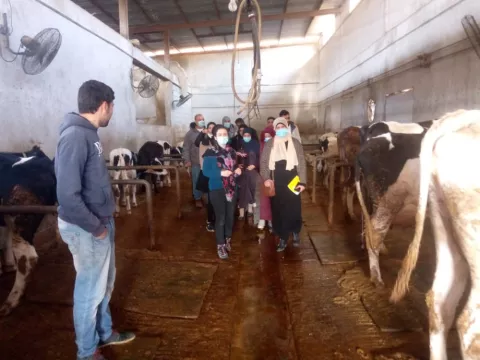
As Lebanon continues to reel from the effects of a multifaceted economic crisis, a competency-based training course conducted by the PROSPECTS programme gave Lebanese and Syrian trainees the key skills needed to advance their careers in Lebanon’s vital agricultural sector.
The PROSPECTS programme is helping strengthen the country’s agricultural sector through a competency-based training course in dairy livestock farming. The initiative focuses on upskilling individuals already working in agriculture and reskilling newcomers to the sector. The programme includes a ten-week course on agricultural machinery repair, followed by seven weeks of on-the-job training, equipping both Lebanese and Syrian trainees with essential technical skills to build sustainable livelihoods in the agriculture and mechanical fields.
Youth engagement
Overview
Youth engagement is a key area of focus for PROSPECTS, recognising that young people, particularly those who are forcibly displaced, face significant barriers to accessing education, training, and decent work.
Young people aged 15 to 24 account for 16 per cent of the world’s population – the largest generation of young people in history. While this demographic faces unique challenges in integrating into labour markets and transitioning from education and training to decent work, forcibly displaced young people face additional barriers in accessing basic services, employment and training. Forty per cent of all refugees are under the age of 18, while young people aged 18 to 24 account for an additional 13 per cent of all refugees. Moreover, nearly 10 million internally displaced persons (IDPs) are aged between 15 and 24. Recognizing the particular challenges these young people face, and the considerable size of the demographic overall, PROSPECTS identified meaningful youth engagement as a cross-cutting and priority area for programming, at both a country and global levels.
PROSPECTS has prioritised the meaningful engagement of young people in its programming at both country and global levels. This engagement goes beyond simply being recipients of services; young people are positioned as partners in the design and delivery of programmes. The PROSPECTS Youth Workstream, comprising focal points from the Government of the Netherlands, the ILO, UNICEF and UNHCR, acted as a joint planning, coordination and knowledge-sharing mechanism for joint agency programming on meaningful youth engagement in PROSPECTS. The Workstream developed an internal, ILO-UNHCR guidance tool TEN STEPS to Engage Young People Across PROSPECTS and Improve Self-Reliance, Inclusion and Resilience to support better and more effective youth engagement.
Image
Key stakeholders
- ILO technical specialists
- Humanitarian partners (UNICEF, UNHCR)
- Government representatives
- Refugee- and youth-led organisations (RYLOs)
- Refugees, internally displaced persons (IDPs) and host community members
FR - Digital and gig economies
'Emerging and key areas of intervention' in Responding to Forced Displacement report
Image
ILO training materials & course
ILO, Start and Improve Your Business (SIYB) website, accessed 2025
Global perspectives on digital and gig economies
ILO, Digital Employment Diagnostic Guidelines, 2023
Local perspectives on digital and gig economies
FR - Youth Engagement
'Emerging and key areas of intervention' in Responding to Forced Displacement report
Image
ILO training materials & course
ILO, Work Wise Youth: A guide to youth rights at work, facilitator’s guide and toolkit, 2024
ILO, Rights @ Work 4 Youth: Decent Jobs for Young People, facilitator’s guide and toolkit, 2015
ILO, Start and Improve Your Business (SIYB) website, accessed 2025
ILO Unicef, UPSHIFT module package
ILO, How to choose my future profession? A step-by-step guide for job seekers, 2021
Global perspectives on youth engagement
ILO campaign on youth rights, Your rights are your superpower
Advancing Young People’s Engagement and Meaningful Participation in the PROSPECTS Partnership
Local perspectives on youth engagement
Iraq: ILO, Promoting rights at work for youth in Iraq, 20 August 2023
Iraq: ILO, Update and Adapt Youth Rights at Work Guide and Toolkit for Iraq, 2023
Kenya: Kenya National Development Youth Policy, 2019
Guidelines - Digital and gig economies
Advocate for evidence-based policy solutions
- Strengthen understanding of how digitally enabled work can support entry and progression in labour markets through approaches that uphold rights at work.
- Assess the digital economy’s job creation potential, with attention to inclusion, equity and work quality, including through tools such as the digital employment diagnostic.
- Apply an integrated approach to digital employment, linking key enablers such as digital infrastructure, skills development, financial inclusion, labour and social protection, and online safety, rather than addressing these in isolation.
- Support the alignment of digital economy priorities with National Employment Policies and Strategies, as well as with broader ICT and innovation frameworks, to foster coherence and policy synergies.
- Generate and disseminate evidence and data on digital labour markets, including through surveys on working conditions, skills needs and access barriers, to inform dialogue, advocacy and policymaking.
Strengthen capacities of communities and digital economy stakeholders
- Foster coordinated engagement among government ministries and institutions shaping the digital employment agenda, including Ministries of Labour, ICT and related agencies.
- Facilitate social dialogue on the digital transformation of work, including through models such as Communities of Practice, to bring together government, employers’ and workers’ organizations and other stakeholders to exchange knowledge and build consensus.
- Promote peer learning and awareness raising of rights and responsibilities among digital economy workers and their representatives, including trade unions, online worker collectives, refugee-led and grassroots groups.
Test innovative solutions that provide access to jobs and income
- Pilot demand-driven skilling models that combine digital competencies with core employability and entrepreneurship skills, linked directly to job placement or business development pathways.
- Support micro and small enterprises, aspiring freelancers and digital entrepreneurs to adopt digital tools that improve productivity, expand market reach and enhance sustainability.
- Promote inclusive innovation by testing solutions in refugee-hosting contexts, where digital employment can offer new pathways to income and resilience.
Digital and gig economies
Overview
The digital economy is expanding rapidly, presenting new opportunities in e-commerce, online freelancing, and platform work and is recognised as a potential source of jobs and economic growth. However, differences in labour laws, social protection policies and employment standards shape diverse business ecosystems and working conditions, impacting how refugees and members of the host community can take part.
In the context of forced displacement, the expanding digital economy offers both opportunities and challenges. On the one hand, it creates new pathways for refugees and host community members to achieve self-reliance and economic inclusion. On the other hand, the rise of digital jobs has also led to significant variations in how work is structured and regulated across and within countries. Unlocking these opportunities requires targeted investment in:
- Access to information and communications technology (ICT) infrastructure, broadband connectivity, work tools and spaces.
- Market-driven digital skills development.
- Supportive legislation and policies for labour market inclusion and rights at work, including for refugees.
- Digital financial access.
- Cybersecurity and digital safety.
Image
Key stakeholders
- Community-based organizations (CBOs)
- Social solidarity enterprise initiatives
- Humanitarian partners (UNHCR, UNICEF)
- (I)NGOs
- Private sector
- Government representatives
13 of 9