

Entrepreneurship training programme
Image
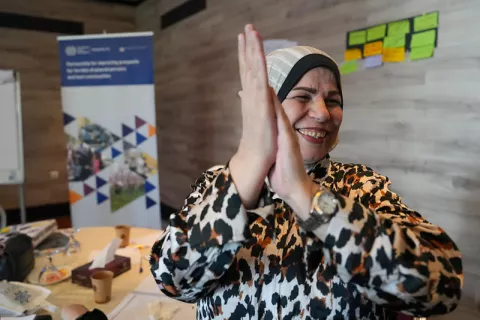
This collection of videos shows how the ILO supported both women and men in Lebanon on various entrepreneurship training programmes.
The Start and Improve your Business (SIYB) Training of Trainers programme marks a key milestone in Lebanon’s efforts to build a sustainable entrepreneurial ecosystem. The ten-day training initiative is part of a broader strategy to certify regional master trainers and enhance business development support across the region.
The ILO has trained more than 650 women and men, the majority of them young people, on its My First Business entrepreneurship training programme, aimed at promoting livelihoods and decent-job creation in the agriculture and agri-food sectors.
Read the Improve your Agriculture Business (IYAB) training guide for farmers and input suppliers (Arabic version).
Find out more about the PROSPECTS programme’s wider learning on youth engagement.
Success story of an ILO Business Plan Competition winner
Image
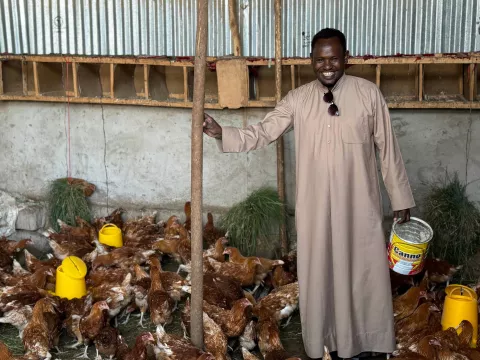
This video shows how a young poultry farmer from Jigjiga, transformed his business with the help of a grant and business training through the ILO's Business Plan Competition in Ethiopia’s Somali region.
Mukhtar, a young farmer from Jigjiga running a micro-sized poultry business, was aware of increasing market demand for poultry in Ethiopia’s Somali region. The first-generation entrepreneur has a wife and three kids and was planning to grow his business to improve his livelihood. However, lack of access to formal sources of finance limited his ambitions. His participation in the ILO Business Plan Competition (BPC) supported by and Hasi Consulting proved to be a gamechanger.
Find out more about the PROSPECTS programme’s wider learning on youth engagement.
Entrepreneurship training combined with support for youth employment in Uganda
Image
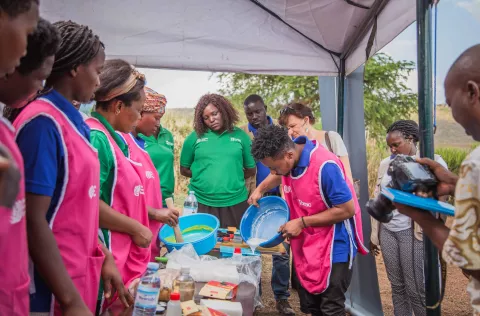
PROSPECTS partnered with Unleashed, a refugee youth-led organization in Uganda, to empower young refugees through business development and training, demonstrating a model where refugee leaders can be equal partners in programming.
Unleashed is a refugee youth-led organization (RYLO) in Uganda formed by two brothers from the Democratic Republic of the Congo. As a result of conflict in their home country, the brothers relocated to the Nakivale refugee settlement in the Isingiro district of Uganda. They started Unleashed in response to the sense of desperation felt by young refugees who lacked real prospects for the future in the refugee settlement.
Unleashed began developing a BDS training curriculum for young people, to support the generation of business ideas that addressed challenges faced by Nakivale residents. They first interacted with PROSPECTS during an SIYB training-of-trainers session targeting the development of refugee trainers. The two Unleashed founders ultimately became certified as master trainers. They subsequently joined the BDSPN, which gave them access to a wider range of training opportunities. They used the SIYB materials to enrich their own BDS offerings in Nakivale and upgrade the skills of refugee trainers.
The Unleashed master trainers later used their experience and knowledge to help the ILO and UNICEF integrate the former’s SIYB curriculum into a social enterprise programme run by the latter. Through their participation in the joint ILO-UNICEF programme, known as integrated UPSHIFT (i-UPSHIFT), the Unleashed leaders developed modules called U-Ideate, to generate business ideas; U-Accelerate, to formalize businesses; U-Love, for digital entrepreneurs; and U-Leadies, which was designed as a stand-alone programme for women. They were ultimately contracted by the ILO to implement i-UPSHIFT in Nakivale, which provided them with practical experience in project design, implementation and administration.
In addition, the Unleashed leaders were trained under the ILO Global Programme on Financial Education, incorporating what they learned into their service offerings. They were further trained and certified as master trainers as part of the ILO programme Promoting Social Cohesion for Peaceful Co-existence through TVET. They used the master-trainer status to train local leaders, CBOs and young people in methods to facilitate social cohesion in training processes. They did so by targeting local football clubs in the Nakivale settlement, which were already bringing young people from different backgrounds together.
Working with PROSPECTS gave Unleashed further opportunities to enhance BDS and community services within the refugee settlement. This included practical experience as an implementing partner of the ILO. Unleashed leveraged resources and complementary work from numerous sources to augment its own BDS, as a business. For example, the organization runs a computer lab funded by the UNICEF social innovation programme, which it put to use in the ILO’s digital skills training. Its lab is also used as a space for other INGO and UN programming, as refugees within the settlement lack reliable internet access.
Unleashed is an example of how an extremely motivated community-based organization can drive responsive programming. The BDS training curriculum was developed and adapted gradually, as the organization interacted with more young, aspiring entrepreneurs and became increasingly aware of gaps in services (such as financial services). The BDS model it has created is currently reliant on donors, although Unleashed does generate a small amount of revenue by charging fees for the use of computer labs. Its main client base comprises refugee entrepreneurs, who are largely unable to contribute financially to the services and so would depend on external financing in the long term.
Moreover, the organization operates in a relatively closed economy, meaning the extent to which the enterprises they support can be scaled up is limited. Despite these challenges, the model provides intangible benefits, serving as an example for aspiring young entrepreneurs in refugee settings. It also demonstrates a model where refugee leaders were positioned as equal partners in programming. They were not only programme recipients, but involved in the design of project activities. They identified needs, led adaptation of tools and training and were instrumental in scaling up training through training of master trainers in their community.
Find out more about the PROSPECTS programme’s wider learning on youth engagement and gender and disability inclusion.
Digitalizing refugee and host community businesses in Egypt
Image
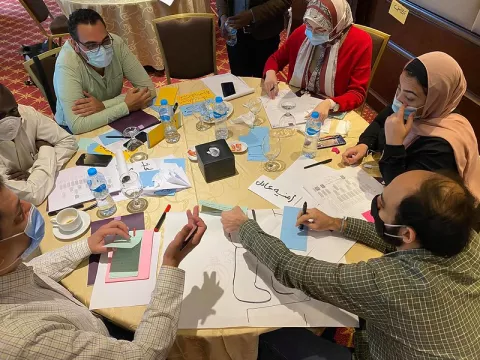
The Digitalize your Business (DYB) initiative in Egypt was developed to support micro and small enterprises run by refugees, by offering services like legal counselling, coaching, networking and specific technical guidance.
Egypt's digital transformation was accelerated by the COVID-19 pandemic, which forced the introduction of new services and business opportunities through e-commerce, digital services and platform work. These aligned with national initiatives such as Egypt Vision 2030. However, micro and small enterprises, including those run by refugees, faced barriers in fully availing of the benefits of the digital transformation. This was partly because of connectivity issues, lack of formal registration and low levels of digital literacy. To address these issues, PROSPECTS Egypt developed a complementary training tool to the SIYB core package. This included practical guidance on the digitalization of business processes and operations, including the use of e-commerce to sell products and/or services online. This was later adapted in Uganda and reformulated in Kenya to address issues related to data privacy and security.
Digitalize your Business (DYB) in Egypt covered the basic requirements and main steps for getting existing or future businesses online through three core modules:
- Developing an online presence
- E-commerce
- Digitalizing business processes.
DYB targeted micro, small and medium-sized enterprises. Refugee and host community entrepreneurs who wished to participate were expected to have basic computer skills and be familiar with internet usage. Read more about the programme in the Digitalize your business teaching manual in Egypt.
DYB was rolled out in Damietta, Greater Cairo and Alexandria, starting with a needs assessment and market research. These processes helped identify opportunities for digital adaptation in MSMEs. The training itself was accompanied by legal counselling, coaching, networking and specific technical guidance relating to the sector or area of business operation. The training also referred participants to additional social, health and livelihood services outside of PROSPECTS, facilitated by partnering INGOs.
While the programme wanted to make sure at least 30 per cent of its beneficiaries were refugee entrepreneurs, the practical barriers faced by the latter necessitated a more proactive approach. Generally speaking, Egyptian-run enterprises were more exposed to digitalization than those run by refugees. The latter also faced different vulnerabilities owing to their inability to register businesses formally. In this respect, trainers had to cater to the different needs of the participating enterprises, highlighting the importance of dedicated business coaches and different follow-up support, such as legal counselling.
The relevance of DYB in refugee-hosting contexts was highlighted by the fact that the programme in Uganda adapted the tool and built on training it had delivered in 2023, called Digital Tools for Business Growth. Two SIYB master trainers were trained on the adapted DYB tool and went on to train 20 DYB trainers in PROSPECTS target locations. The programme in Kenya also made its own adaptation, drawing on content that highlights data protection and digital risks.
Find out more about the PROSPECTS programme’s wider learning on the digital and gig economies.
CCT - Employment services
Youth engagement
- PROSPECTS Jordan helped develop a mobile application for youth in refugee and host communities to get career advice. The app, called My Future Career Path, allowed young players to navigate ten different games while helping them discover their abilities and interests in different Technical and Vocational Education and Training (TVET) career pathways.
- In Uganda, youth representatives were included in the District Employment Services Forums, which helped the Ministry of Gender, Labour and Social Development to understand the specific needs and expectations of young job-seekers and facilitated communication about job vacancies.
- In Ethiopia, Employment Service Facilitation Centres (ESFCs) were established with the Bureau of Youth and Sport. Consultations with the Bureau and young people aligned the centres to the expectations of young jobseekers.
- TVET and educational institutions engaged student networks. In Jordan, the career guidance offices of the Ministry of Education were spaces used by both refugee and host community students. In Kenya, a decree required that all institutions of higher education and training incorporate career guidance units, generating demand for career guidance. In Iraq, partnerships with the University of Mosul and University of Dohuk strengthened their career guidance functions and reached a diverse segment of the student population, including internally displaced persons (IDP), refugee and host community students. The ILO training manuals, ‘How to Choose My Future Profession?’ and ‘How to Organize My Job Search?’ were suitable for students and recent graduates.
Find out more about the PROSPECTS programme’s wider learning on youth engagement.
CCT - Work-based learning
Youth engagement
- Uganda piloted a national apprenticeship scheme in the hotel sector, developing capacity within the relevant ministry and training institutes, and creating a model for replication.
- In Ethiopia, Iraq and Kenya, WBL is integrated into TVET courses to target young people as students, therefore engaging with them via educational settings.
Find out more about the PROSPECTS programme’s wider learning on youth engagement.
Gender and disability inclusion
- The success story of a refugee with a disability who joined the ILO’s welding apprenticeship programme and envisioned himself as an entrepreneur making assistive devices for others with disabilities.
- PROSPECTS worked with JPTC to make their training spaced more accessible for all.
Find out more about the PROSPECTS programme’s wider learning on gender & disability inclusion.
5 of 9