
District Employment Services Forum

Submitted by iloadmin on
Image
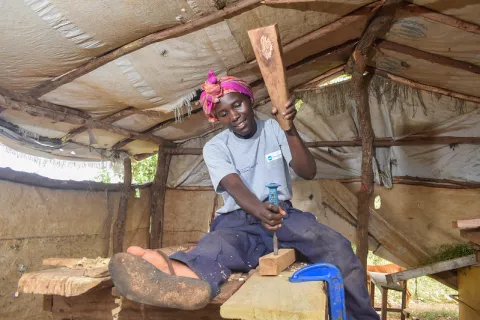
Image of a lady working in a wood workshop with tools

PROSPECTS piloted rural employment services in Uganda, strengthening existing infrastructure and partnerships to improve employment service delivery in rural and refugee-hosting areas.

A rapid assessment of public employment services in Uganda in 2020 revealed gaps in services in the main refugee-hosting districts. These districts were in rural areas and at a distance from public services. The local labour offices serviced by the Ministry of Gender, Labour and Social Development (MOGLSD) were found to be primarily concerned with labour disputes and lacked sufficient capacity to deliver employment services. The introduction of employment services in rural areas had the potential to make hiring practices more transparent and equal for all, services more demand-driven and better matches between employees and the jobs available. Employers would then also find better employees and build confidence in the services thereby communicating more of their employment opportunities through the publicly available services, rather than through word of mouth. PROSPECTS piloted rural employment services in the Isingiro and Arua districts, introducing District Employment Services Forums as a vehicle to translate experience and lessons learned from the pilot into the delivery of more efficient PES.

Prior to the pilot, INGOs in the Arua and Isingiro districts had set up job centres and experimented with delivering employment services targeting rural areas. The main purpose of these projects was to bring employment services to remote and rural areas, but this had not been done systematically or in coordination with PES. PROSPECTS partnered with one of the INGOs to strengthen the model for rural employment services and introduce a mechanism to engage government representatives (including PES), employers’ and workers’ organizations, and young people. This aspect strengthened the coordination function of the PES.

The District Employment Services Forums were strategically placed in line with district development plans, which were the main vehicles for translating national development objectives into work at the district level. The Forums comprised staff from the district governments, the MOGLSD, the Federation of Uganda Employers (FUE) and youth representatives from the local communities in Arua and Isingiro. They provided space for local decision-makers to convene around skills needs and employment service delivery. The FUE’s main role was to engage potential employers at the district level, whereas the MOGLSD helped transfer the knowledge and outcomes of exchanges into PES practices. The Forum also helped the MOGLSD understand the specific needs of district employers and the expectations of young job-seekers. The partnering INGO and youth representatives also used information on job vacancies that were identified through the Forum to communicate with groups of young job-seekers that had registered in the pilot on rural employment services.

One indication of successful engagement through the Forums was the allocation of space by the MOGLSD to house employment services in the Isingiro and Arua districts. The district offices also earmarked a budget for the continuation of services in Arua. The intervention in Uganda is an example of a pilot that made use of existing employment service infrastructure, partnered with an INGO and built networks to engage PES in the process. By engaging district staff from the MOGLSD, PROSPECTS supported strengthening capacity and ownership, while also introducing innovation in the delivery of services in rural and refugee-hosting areas.

Find out more about the PROSPECTS programme’s wider learning about youth engagement

Increasing employability and job opportunities in northern Lebanon

Submitted by iloadmin on
Image
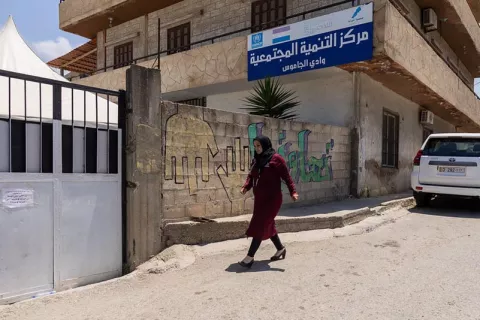
Image of a lady walking past a building on the street

This video story shows how the PROSPECTS team, in collaboration with partners, helped hundreds of Lebanese nationals and Syrian refugees  hone their skills and find jobs amid the country’s multi-level crisis.

Through a joint programme led by the ILO in collaboration with UNHCR and implemented by the Danish Refugee Council (DRC), more than 600 Lebanese nationals and Syrian refugees women and men have been trained , making the job market more accessible and inclusive. Many have since secured job offers or practical training placements with local business owners, improving their chances of long-term economic stability.

Mobile work permit units in remote locations

Submitted by iloadmin on
Image
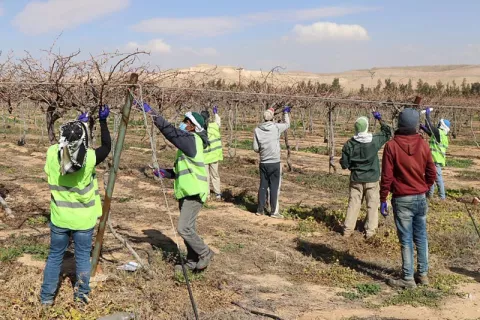
Image of a group of workers planting trees in a field

This video story shows how the PROSPECTS team and partners launched mobile work-permit units to provide essential employment services in remote areas of Jordan.

In Jordan, many agricultural and construction workers in remote areas face limited access to employment services. To address this, the ILO, in partnership with agricultural cooperatives and the General Federation of Jordanian Trade Unions,  introduced mobile work-permit units, which bring employment services directly to workers in hard-to-reach locations, improving accessibility and inclusion.

Through these mobile units, workers can apply for or renew work permits free of charge, with gender-sensitive services available to better support women. Additionally, the ILO and its partners have conducted awareness sessions targeting both workers and employers, further strengthening protections and opportunities in the agriculture and construction sectors.

CCT - Skills profiling, qualifications recognition and recognition of prior learning

Submitted by iloadmin on

Digital and gig economies

  • PROSPECTS Kenya supported the development and implementation of a national RPL framework in collaboration with a digital skills training provider to make the most of existing curricula for RPL certification in digital skills.

Find out more about the PROSPECTS programme’s wider learning on the digital and gig economies.

Career counselling for refugee and host community students

Submitted by iloadmin on
Image
Career counselling for refugee and host community students

PROSPECTS partnered with the Ministry of Education to develop and implement a mobile application to help young people, including Syrian refugees, explore career paths.

In light of high youth unemployment in Jordan (42 per cent among those aged 15–24), PROSPECTS collaborated with the career guidance offices within Ministry of Education public schools. The programme adapted and rolled out a career guidance manual for young people, which enabled career counsellors to provide market-driven career guidance. Since Syrian refugees were enrolled in Ministry of Education public schools, they too were able to benefit from the support provided by the trained counsellors. The aim was to help students decide what professions they were interested in and might want to pursue – either through technical and vocational education or academic pathways. An accompanying mobile application featured a game for students to explore different career opportunities independently. The application, called “My Future Career Path”, allowed young players to navigate ten different games, while helping them discover their abilities and interests in different TVET career pathways. As of mid-2024, the application had been downloaded more than 1,000 times from Google Play and was later made available in the Apple Store. 

Find out more about the PROSPECTS programme’s wider learning on youth engagement

Urgent response to support refugee and host communities in Beirut

Submitted by iloadmin on
Image
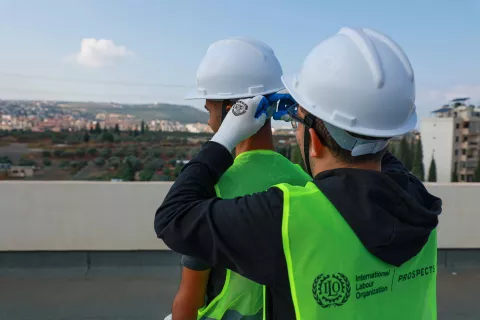
Image of one EIIP worker helping the other fasten the safety helmet

The ILO used its Employment-Intensive Investment Programmes to support the community in Beirut to mitigate the impact of the conflict, in accordance with its mandate to advance social protection and ensure decent work opportunities and economic sustainability in the longer term.

In Lebanon, EIIP was introduced as a rapid response mechanism to address the immediate aftermath of the Beirut blast in 2020. While EIIP was not initially included in the PROSPECTS work plan in the country, the team was able to repurpose funds and support an existing ILO EIIP programme in Lebanon to operationalize rubble removal and street-clearing in the days following the blast. Workers were largely refugee and host community youth, who channelled their energy into helping the community recover from the unforeseen crisis. It was particularly advantageous to be able to use the footprint of the other ILO programme, including staff who were already in place with the necessary technical expertise to carry out the EIIP work at community level. In implementation, Syrian refugee youth were particularly eager to contribute as a sign of solidarity with their host community. In this case, the repurposing of funds to support the EIIP response also demonstrated the agility of both the ILO and the donor (the Netherlands), who were both willing to expedite approval processes to serve a clear and immediate need.

In September 2024, Lebanon witnessed a sharp escalation in large-scale cross-border attacks, resulting in significant loss of life and severe damage to the economy. The recent violence has caused immense suffering and, in response, the ILO developed an emergency response plan to mitigate the impact of the conflict on the country’s residents, in accordance with its mandate to advance social protection and ensure decent work opportunities and economic sustainability in the longer term.

More about EIIP in Lebanon can be found here: https://www.eiiplebanon.com/ 

Find our more about ILO's contribution to the Lebanon Emergency Response here

Building infrastructure in Ethiopia through Employment-Intensive Investment Programmes (EIIP)

Submitted by iloadmin on
Image
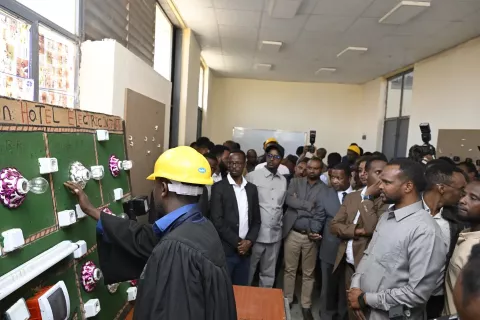
image of a crowd gathering in a room watch a demonstration of lighting by a person with safety helmet on

The ILO, together with the Lutheran World Foundation, is  building a Technical and Vocational Education Training Centre in Kebribeyah, Ethiopia. The centre, which is located in the vicinity of refugee settlements is designed to provide vocational training opportunities for both the host community and refugees.

In Ethiopia, the PROSPECTS team supported an initiative to establish a satellite TVET training centre in the district of Kebribeyah, in Somali Regional State. The satellite centre was the country’s first public TVET training facility in a refugee-hosting area. As a result, jobs were created for refugees and host community members during the construction of the centre itself, subsequently vocational training was provided to refugee and host community students who would otherwise have to travel long distances for TVET training (the closest public vocational training college was 55 kilometres away, in the regional capital, Jigjiga).

Consultations were organized with local stakeholders in Kebribeyah to promote buy-in and ownership, and to provide guidance on relevant, in-demand occupations, including finishing works in construction, general metal fabrication and aluminium works, electrical installation, plumbing and sanitary installation, irrigation technology and cobblestone-laying. Trainers from Jigjiga Polytechnic College were then trained as trainers to deliver courses in the satellite centre. As a component of the cobblestone course, graduates were awarded a trial contract to construct a 500-metre cobblestone road as a demonstration site for EIIP in Kebribeyah. Similar to the case in Kenya, this supported the upskilling of local refugee and host community labour, using a labour-based approach.


Find out more about the PROSPECTS programme’s wider learning on youth engagement

Training youth in cobblestone technology

Submitted by iloadmin on
Image
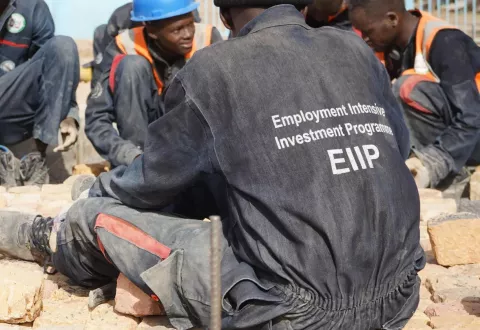
Image of youth resting in a group on a building site wearing a jacket with labels of EIIP on the back

In collaboration with the Turkana County government in Kenya, PROSPECTS supported the paving of the Lodwar fresh produce market using an Employment-Intensive Investment Programmes (EIIP) approach to link infrastructure development with employment creation, poverty reduction, and local economic and social development.

In partnership with the Turkana County government in Kenya,  the PROSPECTS programme supported the paving of the Lodwar fresh produce market using durable cobblestone technology. The project was implemented through the ILO’s Employment Intensive Investment Programme (EIIP), with the county government headquarters providing the venue for training, helping local workers build skills in cobblestone paving. The project promoted the use of locally sourced materials, provided skills training, and created employment opportunities for the local community.

Find out more about the PROSPECTS programme’s wider learning on youth engagement
 

Subscribe to